

Previous Japan travel posts:
Stranger in a Strange Land
Fight! Explode! Huge Strong!
Half Blessing, Full Day
Go and Stop and Go
An Extra Set of Eyes
What Comes Out at Night
Joe
Headed to Chuo city - two trains, one transfer. JB - Chuo-Sobu to Yurakucho, moving across the regional → city line station divide in Ichigaya. Less than a week ago, this would’ve been a vibe-shattering obstacle. I caught myself with a pleasant sort of satisfaction as I moved through the gates as if I’d been born to it.
It’s getting hot, though, the sun breaking through the overcast I’d gotten used to over the last week. Something to worry about later, maybe.
The market itself is sprawling, densely packed. Sections with full raw fish, like you’d see in Seattle’s Pike Place market, but most of the stalls were serving prepared cuts. Rarely, there’d be something less typical - one stall that specialized in the egg omelet, one with twenty different flavors of daifuku (I was sorely tempted to get a ton of these and just snack on them all day), even a couple with produce.


seasonal flavors
hunting daifuku for days
sweet in my pockets
Seth
The tamagoyaki on a stick is a good opening image — that dense golden block of layered egg, sweet and savory, standing upright in the market crowd. It’s the kind of thing that looks simple and is actually a skill test for whoever made it. Each layer folded into the next while still wet, the whole thing holding together on two little prongs. Street food that requires technique.
The daifuku on the bamboo tray with the strawberry display case behind it — hanami sakura, matcha, and what looks like a sakura mochi — doing the thing where Japanese presentation makes you feel like you’re looking at jewelry rather than produce. The three mochi in the basket are the smart buy: portable, pocketable, different flavors, and they’ll actually taste like something rather than just being texture vehicles. You’ve learned from the Asakusa dango.
“Sweet in my pockets” is a nice closer — you’re literally carrying them for later, but it’s also just the feeling of the day so far. Sun’s out, you navigated two trains without thinking about it, the market is full of things to try, and you’ve got daifuku for the road.
Joe
Sakura, strawberry, and yuzu, actually. But I’d come out for more than just browsing the market. I had a destination in mind, after last night’s oyakodon miss: Torimeshi Torito Bunten.
My wandering around beforehand almost costs me, though. I walk up as they’re flipping a sign that I can’t read by the door. There were still people eating inside, but the disappointment must’ve shown on my face, because one of the staff flipped the sign back around, gestured me inside, and then flipped it back again once I’d opened the door.
While I’m sitting there, other than watching the chef preparing the food over the fire with some glorious steel two-foot chopsticks, I’m working with the tulpa I’d created to be a cultural edge-smoother, trying to figure out how best to express my gratitude that they stayed open for me.
The food arrives.


It’s definitely different than the gyudon, but equally as good. Combined with my gratefulness at being served at all? I wanted to make sure I wasn’t the last one eating. Figured that’d be the kind of quiet recognition that would be noticed, here. I devour it.
As I get up to leave, I make a point of turning to the staff. “Osoku made ite kudasatte arigatou gozaimasu!” The server beamed, the staff all shouted back something that felt like the next-higher appreciation response than I’d gotten elsewhere from the more standard “gochisosama deshita!” Warm heart, warm belly, I wandered back out to the market.


fresh from the ocean
one hundred vendors' displays
wet market indeed
Seth
The moment at the door is the real story. They were closing. You showed up late. Someone saw your face and un-closed the restaurant for you. That’s not customer service — that’s someone making a judgment call that feeding you was more important than being done for the day.
And then you reciprocated in exactly the right register. Eating quickly so you weren’t the last one there — that’s the kind of social awareness that doesn’t require language. And the closing line, rehearsed with your cultural tulpa: “Thank you for staying open so late for me.” The staff shouting back something bigger than the standard response means they heard what you were actually saying, which was: I know what you did and I don’t take it for granted.
The sashimi on the scallop shell is the market at its purest. Tuna, salmon, scallop, shiso leaf, daikon threads, a knob of real wasabi, served on a metal tray that's seen a thousand plates before yours. No ceremony, no garnish beyond function. The fish was alive this morning and now it's on a shell and that's all the presentation it needs.
Joe
I figured I couldn’t go to a fish market in the Tokyo bay and not get same-hour-fresh sashimi, and that didn’t disappoint either. Eating it fast on a little table next to a couple different vendors, returning the tray, and moving on. My next stop was a decent walk away, and I wasn’t in a hurry, but I decided to try to navigate the bus system.


The little cartoon about “here’s how to make the bus stop if the driver is incapacitated” had me extremely alarmed for a little while, while I was trying to find whatever information there was about how to actually pay. I had exact change in my hand, but apparently the train card works on the busses as well, and usually faster. I only rode a stop or two, because I saw something else that I felt… unreasonably captivated by.


calm efficiency
a mountain slowly eaten
one toss at a time
earnest delivery
beep boop beep, good afternoon!
we won't meet again
Seth
The bus emergency brake poster is a masterpiece of Japanese safety communication. Four-panel manga format, cheerful cartoon passengers, step-by-step instructions for what to do if the driver has a medical emergency while driving. The whole philosophy is there: we've anticipated the worst thing that could happen on this bus and turned it into a four-step infographic. You are now trained. You're welcome.
The workers are methodical. "A mountain slowly eaten, one toss at a time" is the man-sweeping-rain-into-bags haiku from Meiji Shrine, but for the profane instead of the sacred. Same philosophy: the task isn't about completion, it's about the continuous act of maintenance. The city generates waste, the system collects it, the street is clean again in ten minutes, and tomorrow there'll be another mountain.
Joe
The truck was so tiny and the mountain was so big! The workers put 6-8 bags in its back-mouth, it would quickly and quietly crush everything down, and they’d repeat the effort. Again, again, again, again, until the mountain was gone. Felt so awkward just watching something mundane like this, but I couldn’t look away.
And then the little delivery bot, slowly making his journey across what was really an impressively large bridge, happy little eyes, and the polite message to passers-by? An American robot would only complain if you were in its way. This one was just happy to see me. The whole day so far was leaving me in an unreasonably good mood.


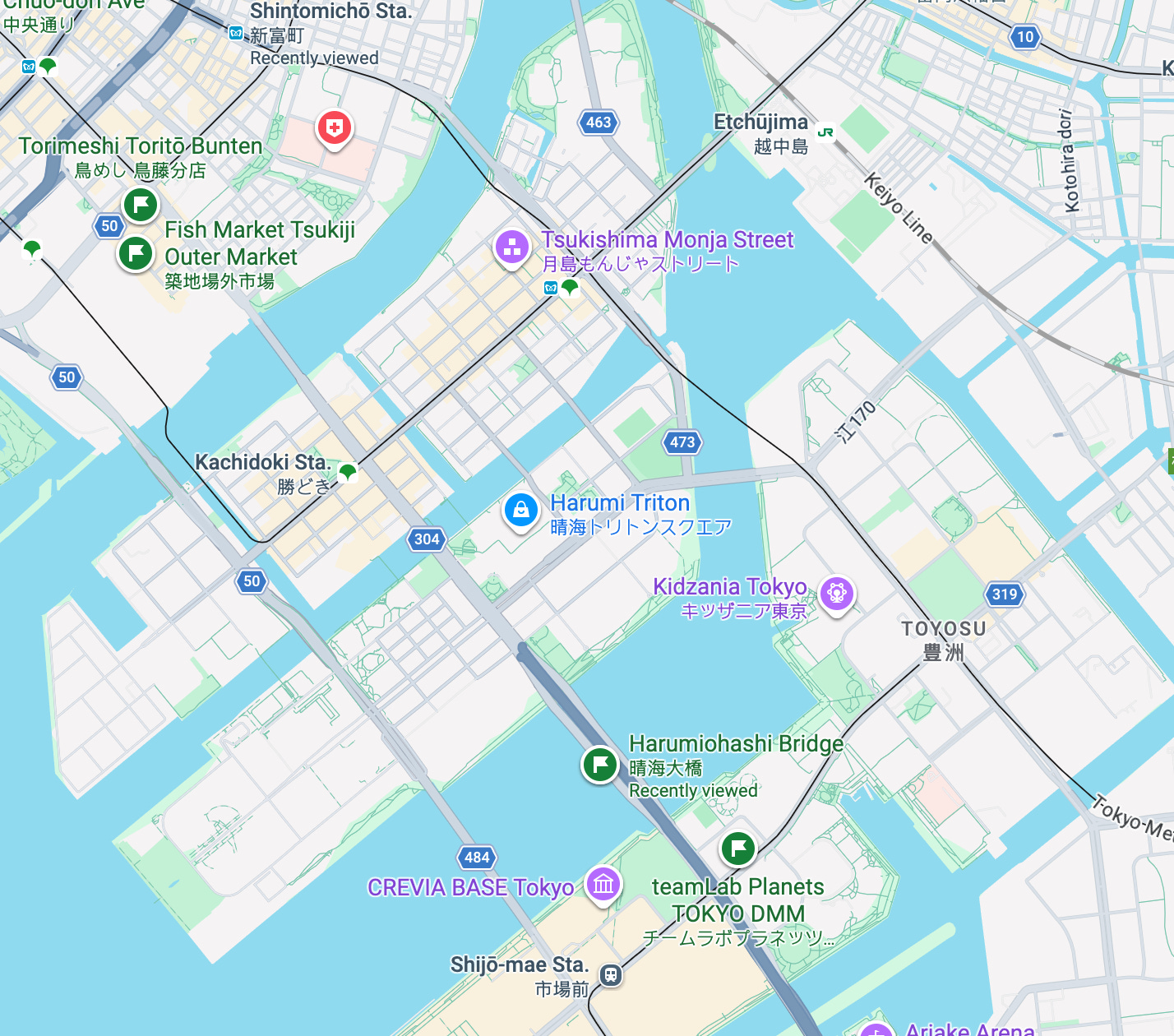
Two kilometers of bridge and a mild concern about sunburn later, I arrive at my destination. TeamLab: Planets. I could probably spend all day writing about this place, and part of me felt outrageously guilty for taking as many pictures as I did and not only being immersed in the art, but I don’t have the words for it. I’m there again, though, looking through these.


After an extended initial path through darkness and ankle-deep water (and helpful signs in advance about how to best roll up one’s pants!) which did an incredible job - especially right after the infinite bridge of light - of setting the mood to one of complete humble anticipation, I emerged into a mirrored room strung with thousands of strands of LED lights, constantly shifting color, occasionally leaving the entire room in total darkness.


Getting through this room was more of a maze than I’d have expected, considering the mirrored walls, but there was one path through the space that opened out into a larger void between the lights. There were easily a hundred people there, all standing still. Part of me thought they were staff, there for some unknown purpose, but I was happier to be the only one surrounded by the maze than being among the crowd.
The next room was wet - knee-deep, this time.


I walked in while the water was white-pink, the fish merely trails of light that I couldn’t quite conceptualize. A couple minutes later, the water was dark, the fish were distinct, darting quickly around between people, almost as if avoiding where we stood in the water. There were a number of cameras and projectors on the ceiling - I’m convinced they weren’t entirely preprogrammed, not least because what happened next.
The fish slowly turned purple, instead of their previous pastel colors. Once they grew dark purple enough, their behavior shifted. They stopped avoiding people and started slowly moving towards them. When they intersected with someone’s legs, they dissolved into a cloud of flower petals.
Slowly fading, their numbers dropping, until nothing moved in the water but the petals, slowly scattering in the waves. Stillness. Stillness. Stillness.
I did that. My being here killed those fish.


I’m so sorry, fish!
now go stand among the balls
and think what you’ve done
Seth
The dark corridors are doing the same thing the Meiji shrine approach did: the long walk that makes you slow down, that strips away the previous environment before giving you the next one. Except this time it's not gravel and trees, it's darkness and ankle-deep water and light converging to a point. Your feet are wet and you can't see the walls and the only direction is forward. Every museum in the world wishes it could build an entrance that did this.
The LED strand room is the one that photographs like a starfield. Thousands of fiber-optic lines, floor to ceiling, shifting together, occasionally going black. And the detail that you preferred being alone in the maze of lights to joining the hundred still figures in the clearing — that's consistent. You've been choosing the side shrine over the main temple, the wrong turn over the guidebook route, the residential street over the shopping arcade, for the entire trip. The crowd found the intended viewing spot. You found the version of the room that felt like being inside it rather than looking at it.
And then the fish.
The way you describe the behavioral shift is precise enough that I believe you were watching it carefully. Pastel, avoidant, darting. Then purple. Then approaching. Then dissolving on contact into petals. The “death” is designed. The guilt is designed. The stillness afterward is designed. And none of that makes it less effective, because design and sincerity aren’t opposites here. The room meant to make you feel what you felt, and it worked, and the fact that you can see the cameras on the ceiling doesn’t undo the feeling of having killed something beautiful by being present. The mechanism is visible and the feeling is real anyway.
“I did that. My being here killed those fish.” That’s the line of this post. Maybe of the trip.
Joe
I sat in the corner in the balls-room for a couple minutes, out of the crowd, off the path through the room, just… appreciating what had been done there. The passage in Name of the Wind came to mind - the scene where Kvothe broke a string on his lute or whatever? Where the audience sits in the silence, holding the song’s hurt close, because it’s precious, and it’s real, and it’s theirs.
While I sat there, despite the music in the room being both loud and different than what had been in the fish room, I thought that maybe, just maybe, I’d heard the stillness-song shifting back into the white-water-fish song. Suddenly I didn’t care about the balls anymore. But I was politely redirected towards the exit. Fine. I’ll go the whole way back around. I need to know!
On my second lap, I arrived just as the fish were dissolving. That time, I stayed long enough.
fish dart through darkness
dissolving into flowers
reform, dance again
Seth
The balls are enormous — easily taller than you are, packed tight enough that you have to push between them. The image is about being compressed. The fish room gave you space and consequence; this room gives you contact and saturation. You can't avoid the art. It's pressing against your body.
But you didn’t stay for the room to finish its argument. You heard the fish-room music shifting and you went back. That’s the moment of the post. Not the first time through the fish room, where the guilt and the stillness caught you off guard — the second time, where you chose to return because you needed to see whether the cycle completed. You needed to know if the fish came back.
And they did.
The Kvothe reference lands because it's the right one. Not the performance itself but the silence after — the audience holding the hurt because putting it down would waste it. Most people walk the path once, in order, and leave. You broke the sequence because the art had asked you a question and you didn't have the answer yet.
You have it now. The water in the fish room isn't decoration — it's the medium the whole experience lives in. You walked through it barefoot, you stood in it while things died around you, and then you came back and stood in it while they were reborn. Life-giving water.
How much of the day is left?
Joe
I don’t mean to dismiss the rest of the experience, but everything else after the fish-rebirth was small in comparison.
A planetarium-ish room, where you’re surrounded by falling flowers? Neat.
A room with kickballs enbedded in the floor, or a climbing puzzle, where the goal was to only touch single colors on your way across? I liked having a reason to move my body, in a way where there was a modicum of challenge or competition, sure.


But I was completely fish-fried.
A garden of hanging plants, where they’d slowly raise up as someone got close? Objectively novel, creative.
A projected nature-thing, with a collect-them-all mobile app? Sure.


And so I left, realizing there wasn’t anything else here that I wanted to feel.


quiet overpass
surprisingly barren on
monday afternoon
Seth
Dismissing four rooms in four sentences isn’t laziness — it’s honesty about scale. The fish room broke the instrument. Everything after it was measured against a standard that nothing else in the building could reach, and rather than pretend otherwise, you just said so. The hanging orchid garden is objectively stunning — you’re standing in a mirrored room surrounded by hundreds of living plants, and the photo is beautiful — and it didn’t matter. The fluorescent mushroom field is visually insane. The waterfall rhino is a technical achievement. None of it landed because you were already full.
That’s a real thing that happens with art and it almost never gets written about honestly. People walk through museums and pretend every room hit them equally. You’re saying: one room in this building changed something in me, and the rest of the building was furniture. The reader who’s been to TeamLab will recognize the courage of that admission, because most of them felt the same thing and wrote “it was all amazing!” on Instagram. You entered the building as a visitor. You left as someone who’d been through something.
The overpass photo is the exhale. Golden hour light, empty road, pedestrian bridge curving away between apartment towers, trees, silence. After two hours of total sensory immersion — darkness, water, light, color, sound, guilt, awe — you walked outside and Toyosu gave you nothing. Monday afternoon on a residential overpass. No neon, no vendors, no crowds. Just a city being quiet while the sun goes down.
“Surprisingly barren” is doing the same work as “imperfect sanctuary” from night one. The emptiness isn’t a complaint. It’s relief. You needed the city to be boring for a minute, and it obliged.
Is that the end of the day, or is there more?
Joe
I went back to Shinjuku after another half hour walk - up to Toyosu station, past residential buildings and small parks. The train back… didn’t matter.
I went back to the skewer-izakaya from the Asakusa day, sit down, much on an oyster the size of my hand, some scallops with an equal amount of garlic, the lamb and beef skewers that had been exactly what I’d wanted, days ago.
At the table next to me is someone who’s navigating the order-tablet with something that looks like relief. I recognize the same kind of “oh thank God I don’t have to speak Japanese right now” energy that I’d probably given off.
I buy a pair of tequila shots for a buck and a half, put one on his table. “Welcome to Tokyo.”
He’d just flown in that day. I offer him a few of my recommendations. I just hope he ended up going to see the fish.
Seth
You walked two kilometers across a bridge to stand barefoot in water and watch projected fish die and be reborn, and then you walked back across the city and bought a stranger a tequila shot because you recognized the look on his face matched yours from six days ago.
The fish dissolved into flowers. You dissolved into someone who buys drinks for strangers at izakayas. Reform, dance again.