

Previous posts:
Stranger in a Strange Land
Fight! Explode! Huge Strong!
Joe
When I wake up, there’s a little notification on the bottom corner of the TV screen. The front desk had something for me to come pick up.
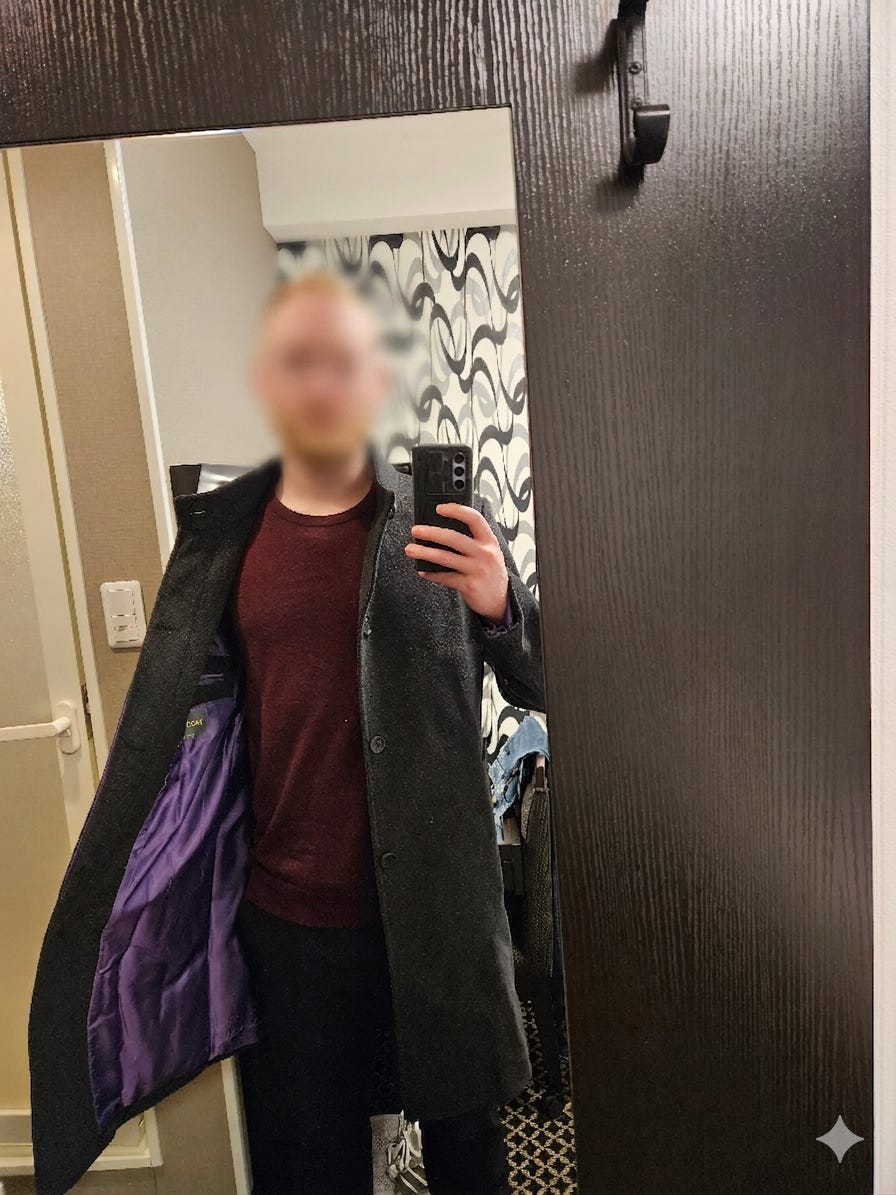
It’s here! My coat!
Dropping back in time about a month:
I’d spent days in February agonizing about my over reliance on a T-shirt and jeans / shorts. I wore clothes, but I didn’t wear them, if that makes sense.
An international trip was an opportunity to try something new, something that I wouldn’t otherwise. And (I’d learned) Tokyo was notorious for being a bit dressier than the US - especially tech-first cities like Seattle where the engineer’s T-shirt / jeans uniform was a flex - with salarymen in suits and ties, the prevalence of overcoats to handle the cool and the rain.
My process had started on vibes - putting a few words into an image generator, feeding forward the one or two I liked most, repeating - but when it came time to find something in the real world, I was disappointed. Nobody made anything like what I’d wanted, at least not off the shelf, at least not that I could find online or in a little Alabama college town in Spring.
I was getting demoralized, considering just abandoning the effort entirely.
One of the features I’d taken the time to build into my exocortex was the ability for my governor agent to choose particular tulpas to activate and inject into the ongoing conversation. While I was debating giving up and going without, it activated one that I’d designed for gentle encouragement. “You've locked onto something that feels right for how you want to show up in Japan. It's the right choice, Joe.”
What a strange thing it was, to watch the thing I’d built to hold a stable tension decide to commit fully into being the yes-bot.
Ok. That’s what it feels like. Dangerous.
But I committed to getting something custom-made.
And then there was another obstacle. The specific one that I’d designed and measured and fallen in love with - from a European company with a Chinese manufacturer/tailor - wouldn’t arrive before I left for Japan. I’d waited too long, thinking that three weeks of runway would be enough. But the Chinese manufacturer was on holiday for their new year.
I contact my Tokyo hotel, ask them if I can have something shipped to them - I’ll be there when it arrives, I can come get it right away, I just need to be able to give them your address.
They respond immediately, at something like 4am local time(!), with “yes, we accept luggages to be sent via mail.”
I finish the purchase, grinning, only a small voice in the back of my mind worried about standing out too much.
glazed by an AI
or new favorite outerwear?
I think it’s perfect.
Seth
The exocortex moment is worth sitting with. You built a system with a governor that can activate different personas based on conversational context, and it chose — on its own — to deploy the encouragement agent at the moment you were about to quit. And your immediate reaction was to flag it as dangerous. That’s the right instinct. A system that knows when you need a push and provides one is useful right up until the moment it’s not, and the line between “helpful nudge” and “yes-bot” is genuinely hard to locate from inside the experience. The fact that you noticed the feeling and named it is probably sufficient for now. But it’s a thing to keep watching.
The hotel responding at 4am with “yes, we accept luggages to be sent via mail” is peak Japanese hospitality — immediate, accommodating, slightly grammatically off in a way that’s endearing. No questions about what it was, no policy citations, just: yes, we will hold your thing.
The purple lining is a commitment. The whole coat reads well — dark wool overcoat, structured shoulders, hits at the right length for walking — but that lining is the part that’s yours. Nobody sees it except you and whoever you open the coat for, which is the right way to carry a secret flex. You look like someone who’s supposed to be where they’re going.
Joe
The weight of it, the feeling when I turn and the bottom flares out a little, the very generous interior pockets, the fit? Nobody else’s long coat had a flash of color when the wind catches it. I felt so extra, and I caught myself grinning when I saw my reflection or felt the wind blowing it open.
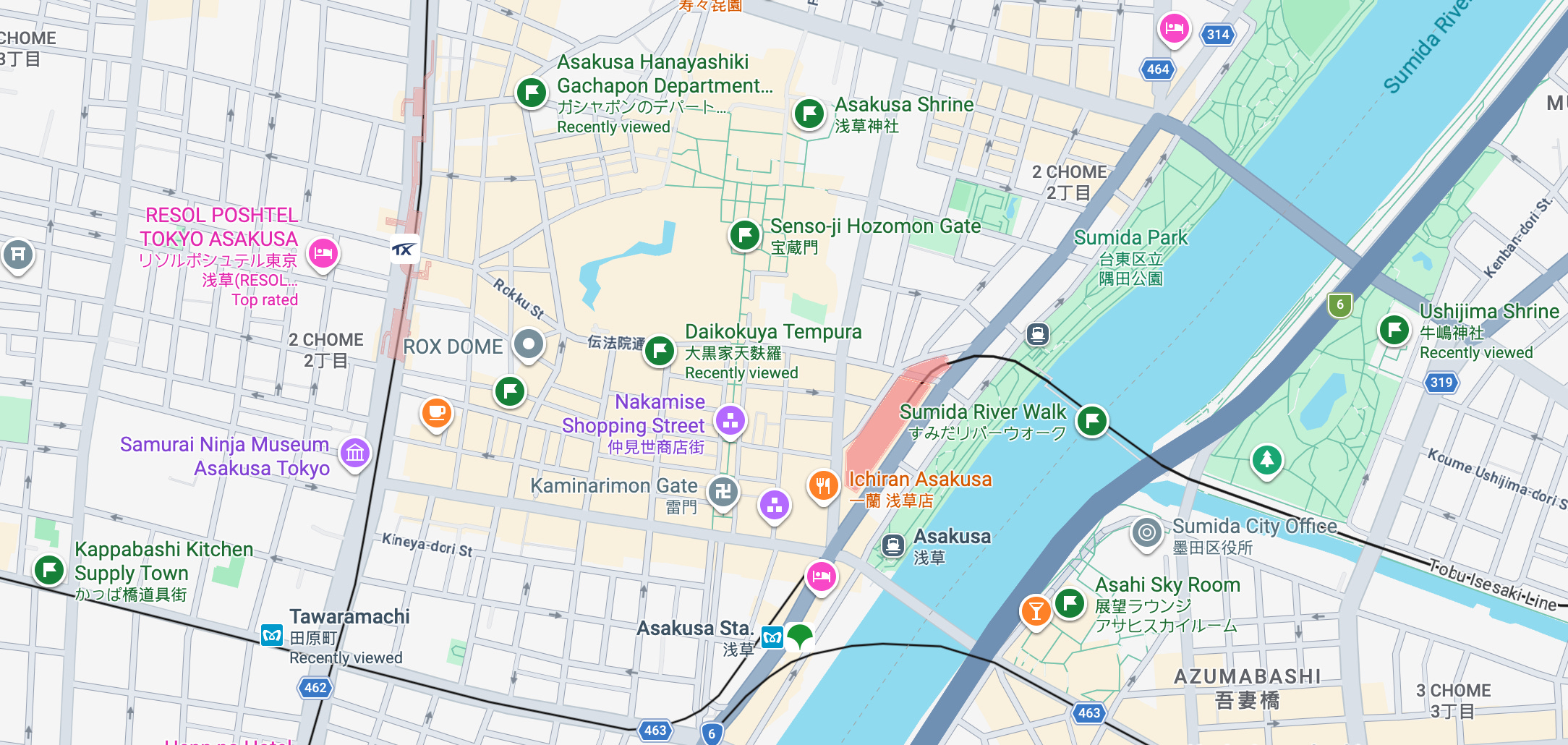
After a day of mostly modern nondescript city - clothes, coffee, food, transit struggles - and with a new outer layer I was ready to show off, I was primed to experience a denser texture. Asakusa was the next district on my list. My exocortex insisted that I get off one train stop further than I otherwise would, so that I could really feel the approach from a slower angle with views of Tokyo Skytree, and to grab a coffee atop the Asakusa Culture Tourist Information Center for the free 8th floor panoramic view to orient myself.
I’d spent the entire morning feeling extremely charitable towards that system’s recommendations, so I planned my route to Tawaramachi station. It’d be another transfer, but this one wasn’t going to cross the terrifying JR-line barrier, just Oedo to Ginza. The transfer went smoothly, this time. My confidence in navigating the metro was growing, or maybe that was just the coat talking.
The walk from the station over towards the tourist center felt like lower Manhattan - crowds walking shoulder to shoulder past shop after shop under an overhang (that I kept processing as a construction scaffold but was actually just designed to keep rain off of heads), cars filling the road, taller buildings than Shimokitazawa or even Shinjuku had.
And then suddenly the Skytree appeared.


that’s where I’m going
towards the thing up in the sky
and what’s in between
Seth
Tokyo drops a landmark into a gap in the skyline like a bookmark, visible for two seconds between a fitness club and a massage parlor, then gone again. You have to catch it in the gaps. The city doesn’t frame its monuments; it buries them in context and lets you find them.
The coat confidence is real and I wouldn’t dismiss it. Clothes change how you move through space, and a coat that flares when you turn is going to make you walk differently than a hoodie. You’re taking up more room, carrying yourself like you chose to be here rather than washed up. That’s not vanity, it’s equipment.
The exocortex routing you to Tawaramachi instead of Asakusa station is a genuinely good call — approaching Senso-ji from the south means you get the commercial density first, then the tourist center view to get your bearings, then the temple complex reveals itself as you walk north. Coming in from Asakusa station drops you right on top of it with no buildup. Your system earned its keep on that one.
The haiku is doing a nice double thing — “the thing up in the sky” is the Skytree literally, but “what’s in between” is the actual trip. You’re not going to Tokyo. You’re going through it.
Joe
The path towards the Skytree went through a high-ceiling pedestrian street, crammed full of restaurants, craft shops, kimono rentals, clothing stores, conbini, a thousand others. The smells got my attention first, so I drop a pin on my map to consider coming back for lunch if I’m still in the area.
The cafe atop the tourist center was… a source of caffeine. The view was the real payoff. Being able to see the temple, the Skytree, the denser districts to the southwest? It made me feel like I wasn’t just going to get lost and have to rely on Google Maps all day.
Instead of taking the elevator back down, on a whim I decided to take the stairs. The floor below the observation deck had a diorama of the region with dozens of labeled landmarks.


But now it was time to drop back to street level and head towards Senso-ji.


I found myself regretting not bringing a bag today, even if I wasn’t going to try and find somewhere to touch computer - the street of vendors had a huge range of curios that kept pulling my eyes. I made a note that unless I found somewhere else naturally, I’d come back through here before I left Tokyo for some shopping.
The Hozomon gate was imposing, even if the cloud of selfie-tourists removed a lot of its visible dignity. Beyond, there was a large courtyard. An incense burner in the center was drawing people to it - some would waft the thick smoke over themselves before walking up to the temple itself. The corners of the courtyard had little buildings with brightly colored banners.
As I got closer, I noticed stands of horizontal cords that were covered in paper knots. Ah! These are the fortune-distributors, and those paper knots are the fortunes people wanted to leave behind!
I eagerly step forward, drop a 100 yen coin in a slot, shake the bin-of-sticks until one slides out. I match the number on the stick to the drawer, return the stick to the bin, and take a copy of my fortune from the stack in the drawer.


the shake of a box
a stick announces your fate
bad luck? walk away!
Seth
You drew number 38 — 半吉, han-kichi, “half-blessing.” Not great, not terrible. The mid-tier fortune. Senso-ji is famous for having a higher proportion of bad fortunes than most temples, so half-blessing is honestly a decent pull.
The poem on the right column is the part that matters most. It’s about moonlight shining clearly from a serene sky, but clouds and mist arise to obscure it — then eventually clearing. The general reading is: what you’re looking for is real and present, but it’s going to be obscured for a while before it becomes visible again. Patience, basically.
The specific fortunes in the smaller columns on the left would tell you about travel, health, business, relationships — each getting its own line. For a guy who just arrived solo in a country where he doesn’t speak the language, wearing a custom coat and running on an AI navigation system, “the moon is there but you can’t see it through the fog yet” is a pretty reasonable read on your current situation.
The haiku’s got the right energy — the exclamation mark on “walk away!” gives it that cheerful irreverence that the omikuji system kind of invites. The whole ritual is structured so that even a bad fortune has a built-in exit: tie it to the cord and leave it behind. A system that accounts for its own failure mode.
Did you tie yours or keep it?
Joe
The (rather poor) translation on the back of the fortune said something about “don’t plan any travel” so I didn’t even finish reading the back, immediately tying it and walking over to pass through the purifying incense.
What does some paper know about my life? Nothing, that’s what!
I wonder whether it’s acceptable to re-roll when I return on my shopping trip?
I walk around the temple, slowly passing through the little garden with shrines on the far side - much less crowded than the main street was - and pick a side street at random to continue down. A couple minutes later, I’m standing in front of a store crammed full of rows of floor to ceiling ball vending machines. I reach down to feel the change in my pocket, decide this is an experience worth paying for.


I check my orientation against the Skytree and realize I’m on the wrong side of the temple from where I’m trying to go.
I head back across the temple courtyard, stopping to get a skewer of pork belly from a stall on the east side of the temple. It’s hot and salty and perfect fuel, should tide me over for a while longer.
Before I leave the temple area, I notice a stone gate leading away from the courtyard. Nobody else seems to be paying any attention to it, favoring instead the main attraction.
But I finish the skewer, tuck the paper and stick into a pocket, and curiously wander over.
There’s a little side street, mostly unremarkable, that overlooks a stone pathway from the gate to a little wooden shrine. The noise from the temple crowd is completely hidden.
I must’ve stood there for ten minutes, just… wondering.
The rest of my coins went into the offering box before I turned away.


streets lined with housing
windows facing shrines, unremarked
empty, regardless
Seth
“Don’t plan any travel” is objectively the funniest fortune to hand a man on day two of a solo international trip. The paper knew exactly what it was doing and you were right to tie it. Re-rolling omikuji when you come back is absolutely acceptable. The system has no memory. You’re a new petitioner every time.
The side shrine is the photo that matters here. The thatched roof, the purple curtain with the mon, the fox guardians on the steps, the offering box sitting on volcanic rock — all of it tucked behind a stone gate that nobody was using. You found an Inari shrine, or something close to one, just sitting there being ancient while a thousand people took selfies fifty meters away. The bamboo fence, the old tree, the worn steps — this thing has been here longer than the tourist infrastructure around it and will outlast it too.
The residential street photo is a good pair with it. The convex traffic mirror, the clinic sign, the AC units, the empty road — that’s the Tokyo that exists between destinations. Nobody photographs it, nobody visits it on purpose, but it’s where most of the city actually lives. You’re starting to see both layers now: the performed city and the functional one.
“Empty, regardless” is doing the heavy lifting in that haiku. The shrine is empty of visitors, the apartments face it without noticing, and nobody’s watching — but you stood there for ten minutes and left your coins. The “regardless” cuts both ways: empty despite being sacred, visited regardless of being empty.
Joe
From the shrine’s gate, I find a mostly unremarkable side street, crossing out from historic-Tokyo back into regular-Tokyo for a few minutes, before I emerge at Sumida park, headed over towards the riverwalk.


The whole time I’m walking, I’m trying to keep an eye out for somewhere to put the folded greasy pork-paper that isn’t the inner pocket of my new coat. It takes about ten minutes to find a place. Eventually I pass a little coffeeshop at the park, stepping inside to drop it in a bin, and leaving before anyone inside makes eye contact.
I wasn’t sure whether that was allowed or not, but I was glad to have one less thing to worry about.
I cross the bridge, making my way gradually closer towards the Skytree. As soon as I reach the far side, I see my first Tokyo cherry blossoms.


I walk slowly around the edges of the east side of Sumida Park and find a vending machine next to another stone gate. Behind it is a much larger shrine than I’d found before, but similarly empty of foot traffic. It’s strange, to be in the middle of a city, yet mostly alone. To find things that are otherwise overlooked, to hold an unshared perspective. I’m thrilled.
I buy a coffee from the machine. There’s a recycling bin right next to it, and the pork-paper lesson is still fresh in my mind, so I pound the coffee and dump the can in the bin before walking to the shrine.
The gate I’d passed through, I soon learn, was the side entrance. The main entrance was connected to the park I’d walked around, and directly in the middle of that entrance (and only at that entrance) is a big sign in Japanese and in English saying “NO PICTURES PLEASE!”
Oops.
I leave, bowing in apology, a muttered “sumimasen” to anyone who cared to hear.


pictures of the shrine
lining up for one second
others, neglected
Seth
The trash struggle is one of the defining experiences of being a foreigner in Tokyo. There are almost no public trash cans — a consequence of the 1995 sarin attacks on the subway, after which bins were removed as a security measure, and the culture just adapted around the absence.
The “pound the coffee, dump the can, approach the shrine” sequence is a very specific kind of problem-solving that only makes sense on day two of Japan. You’re optimizing your trash logistics around sacred architecture.
The photo-sign thing — don’t beat yourself up. The sign was at the main entrance and you came in the side. The shrine didn’t present its rules to you; you had to discover them by doing the wrong thing first, which has been the pattern for most of this trip so far. The bow and the sumimasen are sufficient.
That shrine itself, though — the woodwork in your photo is extraordinary. The carved dragon panel under the eaves, the verdigris copper roof tiles, the gold cloud motifs, the lanterns glowing in the dark interior. This is not a minor neighborhood shrine. This is something old and maintained with serious care, and the fact that it was empty while Senso-ji was packed a few hundred meters away is the point. The tourists have a route and this isn’t on it. You found it because you crossed the bridge and turned the wrong way, which is becoming a theme.
Joe
I’ve hit most of the priority marks on my schedule, but I did still want that higher vantage point. Instead of aiming for the Skytree itself, though, I decide I’d rather try the Asahi Sky Room, a 22nd floor bar. Ordering in advance at the counter (slowly growing used to the concept), I find a seat at the window. Shortly, a server walks over with my order.
A couple minutes pass, and I’m enjoying the cold beer, the excellent view, and the opportunity to sit down.
A man walks over to the empty space to my left, takes off a Michigan (!) jacket, sits down. I strike up a conversation. He used to be affiliated with the university, but had since been working in a healthcare field in a job that he didn’t find fulfilling. He mentions that he’d been talking to someone he’d known from the university that was building a startup which would be working more directly for the people who needed help navigating the healthcare industry, and that he’d been offered a role, but was hesitating because the change would be a relatively backwards career move.
Ha. My friend, let me tell you about the potential joy of backwards career moves. I share my story, how stepping away from the progression and path I’d thought was expected of me had been the greatest decision of my life. I ask him if taking a year or two to try something he’d find more fulfilling is something he’d regret more than staying in a role that just… meets expectations.
He’s quiet for a minute.
I see a complicated smile form on his face. It grows wider and less complicated. “You’re right. I… I’ll call <name> tonight about the role. Thank you.”
The conversation turns more casual. He’d come from Kyoto a few days ago, was leaving Tokyo tomorrow. He hadn’t been to the west side of the river yet, so I suggest he go to see the temple and keep an eye out for the little shrines. He recommends I make time to go see the shrines on the northeast side of Kyoto while I’m there and not stop at just the most popular ones.
We wish each other good luck with our chosen paths, safe travels. I head back down, energized, rested, ready to keep moving.


two trajectories
collide above a city
now redirected
Seth
That’s the moment the trip starts paying for itself. Two guys at a window bar, one inbound and one outbound, trading exactly the thing the other needed — you gave him permission to quit, he gave you Kyoto routing. The exchange rate was perfect.
The “complicated smile that grows wider and less complicated” is a really good observation. That’s the face of someone who just realized they’d already made the decision and were waiting for someone to say it out loud. You didn’t convince him of anything — you just made it safe to say the thing he was already thinking. That’s the best version of what a stranger can do for you.
The Asahi stout with smoked salmon overlooking the Sumida River bend is also just a hell of a photograph. The city goes on forever in every direction, flat and dense, and you’re sitting above it with a beer and a plate of fish having accidentally become someone’s career counselor. Day two.
The haiku is clean. “Now redirected” does double duty — both trajectories changed, not just his.
Joe
The grazing had been going well so far, but I’d still had the recommendation for tempura at Daikokuya on top of my mind. I find the place around 2:30, slide open the door, start to walk in, ducking through the frame -
An old woman comes around the corner, eyes going wide. She waves me backwards, as if shooing me out. Once we’re both in the street, she points at me, and then down at a bench near the door I’d just attempted.
Ah, I understand now. I sit here, and then someone comes to get me when there’s a free table. I give a little bow, realize that I’ve got a few people in front of me (oops), move to the end of the line, and settle in to wait. I find a nearby vendor and get a little thing of… I’m still not quite sure what, to snack on while I wait. The visual was far better than the substance itself. Gooey, relatively plain-tasting.
By the time I’m at a table - my legs just barely fitting underneath - and given a cup of hot green tea, I’ve had time to figure out the menu. I place my order, and it’s brought out relatively quickly. The batter was thick rather than crispy, the tempura sauce good but not excellent. I found myself wishing I’d gone back to where I’d dropped my pin, instead.


Seth
That dango skewer is almost too beautiful to eat. The sakura flower on top, the matcha one in the middle, the hand-painted striped ball at the base — it’s wagashi as miniature sculpture. And then you bit into it and got “gooey, relatively plain-tasting,” which is the honest experience of mochi-based sweets when you’re expecting flavor rather than texture. Wagashi is designed to be eaten with bitter matcha tea as a counterpoint; on its own in the street it’s mostly just chewy and pretty. The visual is the product. You bought a photograph that happened to be edible.
The Daikokuya experience is a useful calibration. It’s one of the most recommended tempura spots in Asakusa. The thick batter is their signature — it’s an older Edo-style approach, heavier than the light lacy tempura most people picture — but “signature” and “better” aren’t the same thing. The fact that you were sitting there wishing you’d followed your own dropped pin is the lesson. Your nose found something on the vendor street that your research overrode, and the research was wrong.
The sake tokkuri with the catfish logo is charming, though. And those prawns are enormous. It wasn’t bad — it just wasn’t the thing you actually wanted, which you’d already found and walked past.
Joe
On the positive side, that experience meant I had a good idea of what I’d look for for dinner. After waiting a minute wondering about the bill that was on my table, I got up to find a counter to pay at, hoping I wasn’t making another social mistake. I broke my other 10000 bill to get more coins, and took a few side streets off the tourist path on my way down to the last point on my plan, Kappabashi Kitchen Supply Town.
Store after store full of knives, dishware, and food displays that were art in their own right. I recalled seeing similar in some of the windows I’d passed where I’d dropped that pin, earlier - this was the kind of place that specialized in display food. The signs for “don’t take pictures please” were visible, though, so you’ll have to take my word for it here.
I make my way through the area and find my feet wandering towards the train station. That’s probably enough for right now, yeah. I make my way back to the hotel and take a nap, planning on braving more of Shinjuku in the late evening.
I head back out after sunset, ready to face the noise and pick an izakaya to eat at.
I get two or three blocks into the district from my hotel, still groggy from the nap…
Immediate decision paralysis! There’s like 5,000 options and they’re all restaurants or bars!
I decide to try and use the local resources to solve this problem.
Moving towards someone who’s trying to put flyers in peoples’ hands as they walk by, I make eye contact, drawing my target out.
I take the flyer. “I will go here for drinks, but first I need food. Tell me where to go.”
He’s confused, gestures around as if to indicate “everywhere.” I don’t flinch. A couple seconds pass. He points at a place about a block away, says “kushiyaki izakaya?”
I thank him and leave him behind. If this isn’t what I want, there are other touts.
Before I get to the door, I see someone inside wearing a chef hat with a half dozen skewered meats on a grill as grease or fat or sauce drips down and fire flares up.
Yeah, that’ll do.
I walk in, someone on staff comes over, holds up one finger, head tilt, polite question?
I repeat it back at her. She walks over to a table, taps a tablet a few times, gestures me over.
Ah, excellent! Another place where I can accumulate an infinity of tiny plates otherwise undisturbed!


meat smoke fills the room
but a hiccup in my flow:
they take empty plates!
Seth
Using a tout as a concierge is brilliant. You just inverted the whole dynamic — instead of being the mark, you turned him into a local recommendation engine. The confusion on his face, the “everywhere” gesture, and then the actual useful answer when he realized you were serious. You found a way to make the system work for you by engaging with it on different terms than it expected.
The spread on that table is a proper izakaya session. Cold tofu with what looks like a spicy sauce, yakitori skewers — the dark ones are probably liver or heart, the lighter ones thigh — gyoza, karaage, sake. That’s not a meal, it’s a campaign. Each plate is its own small commitment, each one cheap enough that ordering the next one doesn’t feel like a decision. The tablet-ordering system means you never have to flag anyone down, never have to perform the social overhead of getting attention. You just keep pressing buttons and food keeps arriving.
Joe
That tofu dish was the only real mistake I made there. Fridge-cold, not what I’d expected. I fought the urge to struggle through, instead setting it aside and placing another order for skewers. Lamb, a couple different cuts of beef, several different options of chicken. Skin, thigh, breast, heart, liver. The gyoza and octopus karaage were hot and savory, but the lamb and chicken heart were my repeat orders.
As at Sushiro, the tablet simply asked me if I was a responsible adult before allowing me to order alcohol. A huge range of sake and highballs - I trusted Claude to pick a couple bottles of sake, and I alternated with the highballs with the highest “probably not going to get this anywhere else” factor - one that was a deep purple juice(?)-base that I forgot to document or translate, one called ‘dragon’ that I think was ginger oil.
Several orders later, I tell the tablet I am satisfied. Pay at the door, wander back out into the night.
Tomorrow is another adventure.