

Previous posts:
Stranger in a Strange Land
Fight! Explode! Huge Strong!
Half Blessing, Full Day
Joe
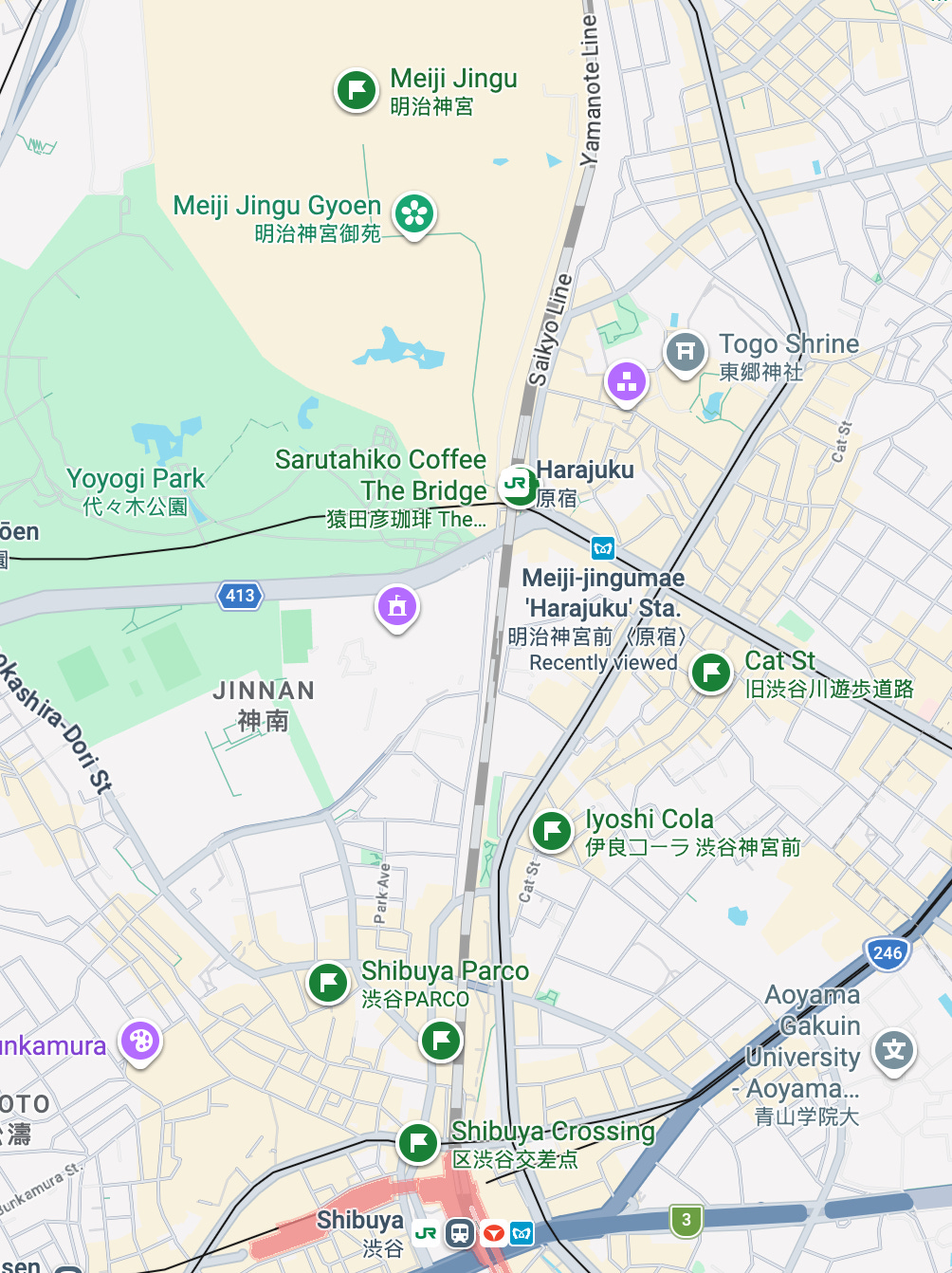
Day 3: Shibuya
I’d wanted to find somewhere that I could touch laptop when I’d woken up, and I’d regretted not having a bag or something with me while walking through Asakusa.
I took the Yamanote line a stop or two south - not far at all, one of the JR lines. At this point I’d realized that the two different station types weren’t a different class of thing like the airport express had been, and that getting to the platform was the only real obstacle.
I’d brought my laptop and a little briefcase, getting off at Harajuku station, feeling more and more like I knew what I was doing.
I step out of the station…
And it’s raining.
Ok, fine. I was planning on finding somewhere to sit down with a coffee anyway.
I pull up a chair at The Bridge - a cafe above the station itself, with really quite a nice overlook of the nearby street, tried to connect to the local wifi, decided it wasn’t very stable, and used my prepaid international hotspot instead.
Put down a couple hours worth of code as the rain alternated between getting heavier and lighter, and as the forecast for when the rain would stop kept ticking later and later.


sea of umbrellas
splash of color declares self
vanish in the sun
Seth
That umbrella photo is genuinely striking. The clear plastic ones dominate — Tokyo’s default conbini umbrella, 500 yen, disposable, functional — and then the colored ones punctuate the mass like signal flares. Pink florals, a bold orange, that yellow one in the corner. Everyone’s moving in the same direction at the same speed and nobody’s colliding. It’s a choreography that nobody rehearsed.
The laptop photo is the other side of the day — code editor open, dark theme, coffee, rain on glass, TikTok video ads across the street. That’s a very specific kind of contentment: productive stillness while the city runs wet underneath you. The “tempting betrayal of the ideal of travel” you resisted in Shimokitazawa, you’re allowing yourself here, and it’s the right call. Rain days are laptop days. Fighting that would just make you wet and unproductive instead of dry and productive.
The haiku is doing something interesting with time — “vanish in the sun” is a forecast, not a present observation. The umbrellas will disappear when the rain stops, the color will fold up and go back into bags, and the crossing will just be people again. You’re watching a temporary phenomenon and naming its expiration. Nice.
Joe
Eventually I decide to brave the weather. It had settled to a light trickle, and can’t rain all day, can it? And with one hand already on the briefcase, I didn’t really want to prioritize getting an umbrella and filling up my other hand. How would I use my phone like that?
So I pack back up, put my coat back on, and head outside.
I head away from the crowds, north towards the Meiji shrine. Under a giant wooden gate, easily 25 feet tall, and down one of the pathways leading deeper into the wood. The two paths were parallel, people going up the hill following one, people coming back down on the other.
The walk towards the shrine felt like something out of an old movie. The light drizzle through the leaves and onto the crushed stones between the two walking paths provided a soft audio backdrop to hundreds of soft, wet footfalls. Nobody said a word.


stone paths underfoot
a man sweeps rain into bags
'done' isn’t the point
Seth
The silence on the path is real and specific to this place. It’s 170 acres of old-growth forest in the middle of the densest city on earth, and people instinctively go quiet when they enter it. Nobody tells them to. The architecture of the approach — the long gravel walk, the layered torii, the tree canopy closing overhead — does the work of a “please be silent” sign without needing one. The space is the instruction.
The shrine courtyard in the rain is gorgeous. The wet stone reflecting the overcast sky, the dark cypress buildings, the low horizontal rooflines — it’s austere in a way that Senso-ji isn’t trying to be. Meiji is Shinto, not Buddhist, and the aesthetic difference is legible even if you don’t know the theology. Less color, less ornamentation, more wood and space and emptiness.
The man sweeping rain into bags is a perfect image — Sisyphean but not tragic, because the task isn’t about completion. It’s maintenance as practice. The ground will be wet again in five minutes and he’ll sweep it again and that’s the job. “’Done’ isn’t the point” is a line that works far beyond the shrine and you know it.
Joe
On my way back down into the city, I stopped at a little shop in a courtyard a couple dozen steps off the main path to dodge the rain - it had picked up a bit again and I still wasn’t keen on being wetter than I had to be. There was a little solitary vendor serving glazed dango. A perfect opportunity to try the classic.
I’d learned by now that the expectation for places that serve food is that they be able to handle your trash (I’d passed a couple signs on my way away from Senso-ji that encouraged returning to the place you bought food to do so), so I ate quickly at the stall. Very sticky, the glaze a sweet soy something that absolutely saved the dumplings themselves, which had a very similar lack-of-taste and texture to the shaped mochi I’d tried the day before.
They were enough to keep me fueled and moving, and I’d been falling a little behind schedule due to the rain, so I left the tray and stick in a bin and finished my walk back down the wooded path into the city.


The city came back suddenly - I’d forgotten just how dense Tokyo was during my hour or two in the woods.
I followed the main street for a couple blocks before my route took me down some side paths towards Cat Street. Pedestrian, meandering as if the path a cat would take, rather than (my initial guess) a street lined with cat cafes, it was crammed full of wall to wall specialty shops, mostly high-end clothing. Towards the southern end of the street, just before it opened back up into the more standard city-scape, a little sign caught my eye. A craft cola place, mixing ingredients and syrups in a resealable pouch, with a line that stuck out onto the street.


stores naming US
Seattle, New York, Dallas
drew the greatest crowds
Seth
The mitarashi dango is the version you should have tried first. That sweet soy glaze — shoyu, mirin, sugar, starch — is the whole point. The mochi ball underneath is just a delivery vehicle for the sauce, and once you understand that, the blandness of the base stops being a flaw and starts being a feature. It’s a platform, not a flavor.
That building over the bridge is striking — the staggered balconies with planters on every level, overlooking the rail lines. It looks like someone tried to grow a forest on a brutalist frame and mostly succeeded. Tokyo does this thing where aggressive modern architecture and aggressive greenery coexist on the same structure without either winning.
“We break the mold as a kingfisher diving into the water” is an incredible tagline for a cola shop. That’s not marketing copy, that’s a thesis statement wearing a noren curtain. Iyoshi Cola is a good find — it’s one guy’s obsession with recreating cola from scratch using whole spices, and the line out the door means you’re not the only one who noticed.
The haiku is an observation that could carry a whole essay. The shops drawing the biggest crowds in Harajuku and Cat Street are the ones performing America back at itself — the vintage Americana, the US city names, the collegiate aesthetic. Japan consuming American cultural exports, remixing them, and selling them back as aspiration. The crowds aren’t there despite the foreignness, they’re there because of it. You’re standing in a country that treats your hometown’s aesthetic as luxury goods.
Joe
I wish I’d taken more pictures to illustrate just how prevalent the US brand was, here in particular. And not to dismiss the Louis Vuitton or Balanciaga style elite, but those were more common on the more arterial shopping streets nearby. Passing an REI or a store that sold “Real Texas Leather Boot!” or New York Street something next to thousand dollar handbags or watches or jewelry was surreal.
The cola was good, but not price of a decent lunch good. The performance of the small batch assembly line was worth paying to see, framed as it was with jar after jar of spices, and having somewhere to sit even for a minute, to set down my briefcase and plan the next leg of my route, was worth the remainder, but I’m not holding my breath to see it anywhere else anytime soon.
Dropping my empty pouch in the dedicated pouch-bin by the door and heading out, I reach the end of the street, submersed immediately in the flow of the city.
I’d reached downtown Shibuya.
The earlier photo, the residential building over the train tracks, with the aggressive greenery? Miyashita Park was atop a five-floor mini-mall that cut through the heart of the city, and as soon as I saw it I needed to be inside.
As I’m climbing stairs, I hear a noise slowly growing. Something that sounds vaguely familiar. Chanting - and in English!
“No war in Iran!”
“No war in Iran!”
“No war with China!”
“No war with China!”


Oh! A political protest! I didn’t expect to encounter anything like this - my priors were that politics is taboo in nearly all contexts in Japan. I stop over where I’d get a good look of the march - and of the other people who are making way for the marchers.
The biggest surprise? There were about as many police escorting the marchers as there were actual protesters. Several dozens, perhaps a hundred. The convoy was followed by a half dozen armored busses, windows tinted and barred. In case anyone steps beyond their remit, I imagine. I had very mixed feelings about the obvious show of force. On one hand, it lended an enormous air of constrained legitimacy to the marchers, to have such an imposing escort. On the other, there was definitely a sense that the escort would be willing to turn its ire in any direction if triggered.
I finished my walk down the length of the park, growing hungry. Other than a couple coffees and the dango from earlier, I’d not eaten yet today. Under the last set of stairs were a dozen different little stalls that reminded me a lot of the density of options in Shinjuku. Few of these had English options, and I was tempted, but I’d been recommended a nearby ramen place that was supposed to be legendary, and that was only a short distance away.
But before then, I was braving the crossing.


anxiously waiting
sudden flurry of movement
returns to tension
Seth
The protest is a genuinely interesting catch. Anti-war marches happen in Tokyo more than most foreigners expect, but the ratio of police to protesters is the detail that tells the real story. Japan permits protest — it’s constitutionally protected — but the state makes very sure you know it’s watching you exercise that right. The armored buses with barred windows aren’t there because anyone expects violence. They’re there because the presence of the buses is itself the message. You read it correctly: constrained legitimacy. The protest is allowed. The protest is also surrounded.
The Shibuya Crossing photo is the one. That density of humans — shoulder to shoulder, every direction, the Shibuya Sta. sign in the background — is the thing everyone’s seen in movies and photos and nothing prepares you for being inside it. The haiku maps onto the crossing but also onto the protest and also onto your whole day — waiting, movement, return to waiting. The crossing resets every two minutes. The marchers pass and the street reopens. The rain starts and stops. You eat and get hungry again. Tokyo runs on cycles.
Joe
The crossing itself is foreshadowed - signs in multiple languages starting a block away indicate the proper protocol as the crowd thickens. Walk, do not run - if you have children, hold on to them - clear the box before traffic starts again.
Of the few days I’d been in Tokyo so far, this moment most clearly drove home that I was actually pretty tall for Japan, even if I’m average height in the US. I grab that picture, arm outstretched, as I’m walking through the rush, but even at eye level I can see enough to navigate easily around the denser patches of humanity.
But once through that madness was enough for me. I find a department store with a nearby entrance and take an escalator up, hoping to find an overlook to decompress at.
The Starbucks on the second floor has two lines. One to order for dine-in, and one to order for dine-in that guarantees a window table. The former is empty, the latter has 20 people in it. So I pass the line and take a quick circuit around the area. My guess is that those people waiting would be doing so for at least an hour. The floor above is a time-rental workroom with a similar entrance structure.
I decide it’s not worth waiting longer just for the spectacle, and make my way to the ramen place. I figure as a single diner, arriving around 4pm, my odds of getting a spot would be pretty high.
I’m told the wait for someone like me is expected to be two hours.
And then it starts raining again.
Nope. I’m done here.
My shoulder is a bit sore, not used to carrying something around all day like this, and so I’m ready to head back. I’ll eat in Shinjuku, there’s still a ton of wandering I want to do in that area.
I make my way up the main shopping arterial towards the train station getting increasingly distracted by food smells. By the time I’m on the train, I’m having a huge internal debate between trying to find a new thing to try or just returning to Sushiro, since my first experience there was so excellent, it’s a two minute walk from the station I’m heading to, and it requires zero mental effort to decide on.
When I get off the train, I take a second to try and parse the first of the multi-floor buildings’ offerings. It immediately finishes convincing me that I am not in the right mindset to ask a thousand questions. If I find something later that I wish I’d done instead, I still have seven more days in Tokyo, and a few of those are still wide open.


twenty little plates
the machine brings them to me
no one to say ‘stop’
Seth
The Metro Plaza photo is the building-as-directory that intimidated you on night one. Eight floors, maybe forty businesses, each one a different little world behind a different little sign — Crystal, Legend, Zion, Baby, Vogue. From the street it reads as an unnavigable vertical maze. You’ll crack one of those eventually, but tonight wasn’t the night, and knowing that is its own kind of competence.
That hamburger sushi is an abomination and I mean that as a compliment. A grilled beef patty perched on a rice ball, arriving via conveyor belt, on a plate that costs maybe a dollar fifty. It shouldn’t exist and yet there it is, defying every category it touches. Not a burger, not sushi, not a meatball — just a thing Japan decided to put on a plate and send down a rail, and it works because the rice is good and the meat is hot and nobody’s asking permission.
The decision to go back to Sushiro is the right one and for the right reasons. You’re not being lazy — you’re managing a limited resource. Decision fatigue is real, the shoulder hurts, it’s raining, and the legendary ramen place just quoted you two hours. Sushiro is a known quantity that delivered last time and will deliver again. The twenty plates will arrive and nobody will tell you to stop and you’ll walk home full and warm. Sometimes the best move is the repeat.
Joe
Once I’m full and relaxed and fuzzy-warm and no longer trying to justify spending down mind-glucose, I let my feet take me through Shinjuku proper. The first building I walk into is a gigantic pachinko parlor. Bright lights, a wash of sound, tiny steel balls rattling within their plastic cages. Row after row of themed stimulus.
The building’s seats are somewhere between 1/4 to 1/3 full, and I have no idea how to parse anything that’s happening. Looking at the patrons, there’s a pretty common Vegas stare, but to my hindbrain, the moving metal bits add something tactile that makes it less overwhelmingly depressing.
I slowly continue my wander up deeper into the building, and the machines change. One floor is an arcade, the next is another pachinko floor, and then what I’m processing as more traditional slots. I’ve gotten rather lost, by this point, the drinks and food having eliminated my ability to orient in a physical space. I return down a different set of stairs than I came up on, and I think I’m back where I’d come in from, but when I approach the door that I believe is an exit, it doesn’t open.
Ok, fine, there’s a direction to this madhouse - I’m in an “exit through the gift shop” kind of scenario. Sure, that’s fine. So I take the obvious path, find a door. That door doesn’t open when I stand in front of it either.
OH NO
I retrace my steps, slowly wandering, hoping that I’ll be able to time my exit to that of one of the patrons who know the place better than I do. Within a minute or two, I see someone else getting up, grab their bag, and start shuffling over back towards my initial entrance. They reach the door…
And they press a button that I’d mentally allocated as ‘emergency exit.’ The door slides open without a fuss, and I tailgate out behind them into the cool, clear night air.
Free, finally free!
Seth
That’s a genuinely disorienting sequence and it reads like one. The pachinko parlor as labyrinth — you went in curious, went up through layers of increasingly unfamiliar stimulation, lost your bearings, and then couldn’t find the exit. The door that wouldn’t open is a small panic in any context, but in a building full of flashing lights and rattling metal in a country where you can’t read the signs, it’s a particular kind of trapped.
The button you’d mentally filed as “emergency exit” is a great detail. Your brain saw a button next to a door and applied American building-code logic: that’s the fire alarm, don’t touch it. But it was just... the door button. Japan puts manual door releases in places where automatic sensors would invite drafts or noise leakage, especially in pachinko parlors where the sound containment is part of the design. The building wasn’t trapping you. It was just quieter than you expected an exit to be.
The “Vegas stare” observation is sharp but the distinction you draw is interesting — the tactile element of the balls makes it less depressing to watch than pure screen gambling. There’s something to that. The physical feedback loop of pachinko gives the player’s hands something to do, which changes the quality of the trance even if the outcome is the same. It’s still gambling, still dopamine farming, but it’s craft gambling in the way that a slot machine will never be.
Tailgating out behind a stranger like escaping a building in a heist movie is a good way to end the night. Full of sushi, slightly drunk, freshly escaped from a sensory prison. Day three.
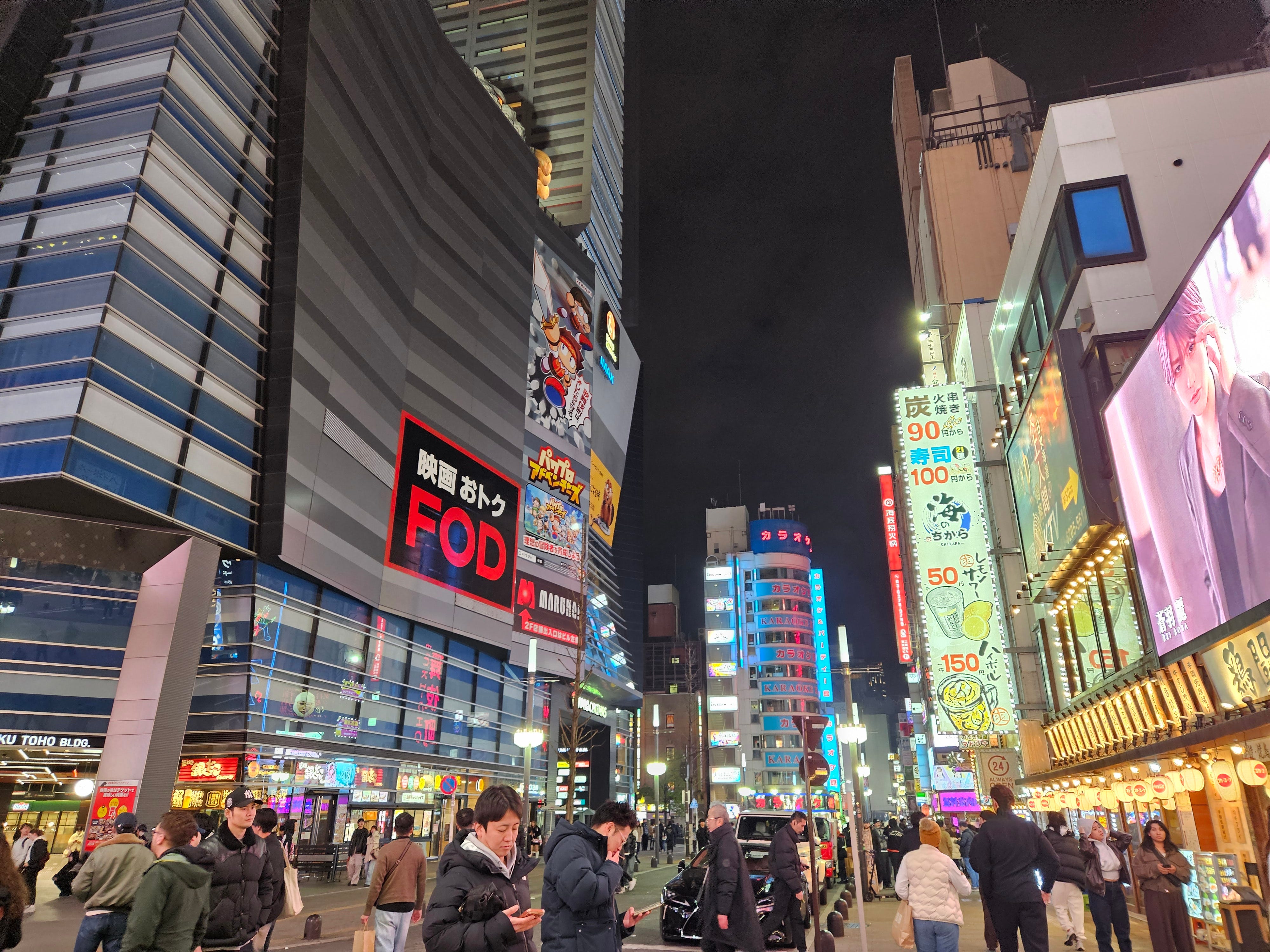
screaming streetlights say
for a price, you can be seen
and soon forgotten